

Graphic design in Tunisia: visuals for social media and sales materials
Visuals built for their channel and their language, plus templates that let your team publish without bending your brand out of shape.
Reply within one business day
Creative studio
- deliverables
- 7
- steps
- 4
- Tunisia
- Europe
- Middle East
They move forward with us
 Énergie et réseaux électriques
 Architecture d’intérieur
 Sécurité incendie et protection individuelle
 Services pétroliers
 Sécurité incendie et automatisme de portails
 Hydrogène vert et équipements industriels
 Formation continue
 Formation professionnelle
 Motos électriques
 Architecture d’intérieur, organisation professionnelle
 Machines industrielles
 Promotion immobilière et bâtiment
What you get
What the service includes
In short
AD AZUR DIGITAL provides graphic design in Tunisia, from its studio in Sfax, turning your brand into working materials: social media visuals, ad creatives, sales presentations, brochures, catalogues, product sheets, exhibition stands and infographics. Each piece starts from a specific use (who will see it, on which channel, and what they should do next) and then gets the format, hierarchy and language that fit.
Read the full answer
The studio works in English, French and Arabic, with Arabic layouts composed right to left rather than mirrored at the last minute. It serves Tunisian SMEs, European companies and agencies looking for a nearby design team that works in French and English, and brands addressing the Gulf and the wider Middle East. You receive channel-ready visuals, print-ready files, editable templates for your team, the source files and the rights status of every asset. The first step is a free audit of your current materials.
A purpose behind every visual
Every request states the channel, the audience and the expected action: a click, a quote request, a read or an application. Composition and message hierarchy follow from that.
Your guidelines, applied without drift
We start from your existing identity: colours, typefaces, logo and tone. If it is missing or contradicts itself, we say so before multiplying visuals.
Formats ready for every channel
Social media, ads, presentations, printed documents: every file is delivered at the dimensions, colour profile and weight its destination expects.
Arabic composed, not flipped
Arabic typefaces chosen for legibility, right-to-left reading, text lengths reworked: your Arabic versions stand on their own, with no rough mirror effect.
Templates your team can use
Editable templates in Canva or Figma, with locked areas and a short guide: your team publishes day to day without breaking the layout.
Print files properly checked
Bleed, converted colours, embedded fonts and a proof review with the printer, to limit unpleasant surprises when the job comes off the press.
Deliverables
What you receive
- A written brief per piece: objective, audience, channel, key message, languages and who signs off
- Finished visuals, adapted to each channel's formats and to every planned language
- Print-ready files: checked PDF, bleed, converted colours and embedded fonts
- Editable templates (Canva or Figma) with locked areas and a user guide
- Open source files, organised and named, alongside web and social media exports
- A library of graphic elements: icons, illustrations and composition rules
- Rights status: the licence and reuse terms of every font, image and illustration
Method
How we move forward
- 01
Free audit of your materials
We review your visuals, guidelines and channels, then list what blurs the message and what to produce first.
- 02
Brief and first direction
For each piece: objective, audience, format and languages. A first composition is shown in context, on a phone or a printed mock-up.
- 03
Production and adaptations
The approved visual is adapted to the planned formats and languages, with grouped feedback and a single person making the call.
- 04
Handover
Source files, exports, print files and templates are handed over with the rights status, so your team can take it from there.
Everything worth knowing before you startThe full guide, with the recurring questions and who it is for.
Who is it for?
Who this service is for
SMEs and manufacturers in Tunisia
In Sfax, Tunis, Sousse or Monastir: catalogues, product sheets, stands and sales visuals that match your know-how, for the local market and for export.
Companies and agencies in Europe
Businesses in France, Belgium or Switzerland, and agencies looking for white-label design support: a French- and English-speaking team in a nearby time zone.
Brands addressing the Gulf
In the UAE, Saudi Arabia or Qatar: Arabic-first or bilingual Arabic-English materials, composed in each language for a campaign, a launch or a trade fair.
Marketing teams without a designer
You have guidelines and a calendar but no time to produce every visual: we take on production and leave you templates for everyday needs.
The guide
What does graphic design in Tunisia actually cover?
In many companies, visuals are born in a rush. A post that has to go out before lunch, a brochure to print for a trade fair, a deck finished the night before a meeting. Each one is made by whoever is free, with whatever files they can find. A year later, the brand has a dozen faces, and none of them quite matches the website.
Graphic design gets you out of that improvisation. It turns your identity into working materials: social media visuals, ad creatives, sales presentations, brochures, catalogues, product sheets, roll-up banners, exhibition stands and infographics. At AD AZUR DIGITAL, in Sfax, every piece starts from a simple question: who will see it, where, and what should they do next? The composition, the text hierarchy and the format follow from the answer.
Graphic design is part of our Creative studio. It works alongside the studio's other disciplines and our marketing teams, so no visual is delivered without knowing where it will be published.
Do you need a brand identity before producing visuals?
In most cases, yes. Graphic design applies rules: colours, typefaces, logo usage, image style, tone of voice. Without those rules, every visual reinvents them, and consistency depends on the designer's memory.
If you already have brand guidelines, we start from them, even when they are imperfect. We flag what gets in the way of production, such as a colour that is unreadable on mobile or a typeface with no Arabic version, and propose limited adjustments. If the guidelines are missing or contradict themselves, it is wiser to start with brand identity work than to multiply visuals you will have to redo. We will tell you during the audit, not after the tenth post.
Which materials should you produce, and for what purpose?
A good visual is judged first by its use. The same message is not composed the same way on a phone, on a meeting-room screen or on a roll-up banner seen from several metres away. Here are the materials we produce most often, and what shapes them:
| Material | Main purpose | What sets the format | Watch-out |
|---|---|---|---|
| Social media visuals | Build awareness, explain an offer | Platform, mobile reading | Text legible without zooming |
| Ad creatives | Win a click or an enquiry | Placements and ad platform rules | One message, one call to action |
| Sales presentation | Support a meeting or a tender | Presented live or sent on its own | Clear without the presenter |
| Brochure, catalogue, product sheet | Help buyers compare and order | Print or PDF sent by email | Accurate, up-to-date product data |
| Roll-up, stand, signage | Get noticed at a fair or on site | Reading distance | Few words, strong contrast |
| Infographic, diagram | Explain a process or steps | Website, report or post | Simplify without distorting |
The grid also helps you say no. If a piece has no clear audience or channel, we will advise you not to produce it.
How do you keep social media visuals consistent?
Creating social media visuals takes method more than isolated flair. Brands often post several times a week; without a system, every post becomes a new poster. So we define post families, such as announcement, tip, product, behind the scenes or hiring, each with its own structure, text hierarchy and reserved areas.
Carousels follow a reading logic: a first slide that asks the question, slides that move forward one idea at a time, and a last one that says what to do. Vertical formats allow for the areas hidden by each app's interface.
We produce the visuals; strategy, the content calendar and community management belong to social media management. The two combine well, but you can also hand only the visuals to the studio and keep publishing in-house.
How does one visual work in French, English and Arabic?
Our three markets read differently. In Tunisia, a single piece often mixes French and Arabic. In Europe, from France to Switzerland, French and English dominate. In the Gulf, in the UAE or Saudi Arabia, Arabic often comes first, with English alongside.
An Arabic visual is not a French one flipped over. Text length changes, the Arabic typeface must be chosen for legibility at small sizes, and reading direction moves the hierarchy: what catches the eye first shifts to the right. Arrows and directional icons are reversed; the logo, photos and numerals are not. We compose each language as a version in its own right, then check line breaks, numbers and alignment on the final file.
What changes between print and screen?
A file that looks perfect on screen can disappoint on paper. Print needs colours converted for the press, bleed, images at sufficient resolution and embedded fonts. We prepare these files for the printer of your choice, in Tunisia or elsewhere, and review the proof with you before the run.
Screen work, on the other hand, must stay light and legible on a small display. We deliver exports suited to each destination, so your website and campaigns do not load images heavier than they need to be.
Why deliver templates rather than locked files?
Because your team will keep producing without us. A last-minute announcement, a product sheet to update, a job ad: these needs do not always justify an order to the studio.
So we deliver editable templates in the tool your team already uses, often Canva or Figma. Key areas are locked, text and image slots are defined, and a short guide explains what to change and what to leave alone. A template does not replace a designer for a campaign or a trade fair, but it stops day-to-day work from undoing the groundwork. We explain the approach in a consistent visual identity across every medium.
How does a design request run?
- Brief: objective, audience, channel, key message, languages, publication date and the person who signs off.
- First direction: a composition shown in context, on a phone screen or a printed mock-up.
- Revisions: feedback grouped and written down, to avoid contradictory versions.
- Adaptations: every planned format and language, checked one by one.
- Handover: source files, exports, print files, templates and rights status.
What depends on you?
A visual cannot fix a muddled message. Approved copy, references and product data need to come from you, or be written with the studio's copywriters. Images matter just as much: a real photo of your workshop convinces more than a stock image. When you have none, product and corporate photography steps in.
Plan for one person who makes the call, and realistic deadlines when a printer or a trade fair sets the date. Generative AI helps us explore directions or adapt formats; it never invents your products, your premises or your people.
How do you get started?
The starting point is a free audit of your current materials: what works, what blurs your brand, what to produce first. Our engagement options are set out on the Offers page, and the exact scope is quoted after the audit.
FAQ
Frequently asked questions
The questions our clients in Tunisia, Europe and the Middle East ask before starting. Another question? Write to us.
How much does graphic design cost in Tunisia?
Cost depends on the number of pieces, the versions needed per channel, the languages, print preparation and whether you want editable templates. A set of social media visuals is not priced like a bilingual catalogue. Our engagement options are set out on the Offers page; for a specific need, the quote is built after a free audit of your materials, which also shows what does not need redoing.
What is the difference between graphic design and brand identity?
Brand identity sets the rules of your brand: logo, colours, typefaces, image style and usage. Graphic design applies those rules to concrete materials: posts, ads, brochures, presentations and stands. The first is decided rarely; the second is produced continuously. If your guidelines are missing or contradict themselves, start with the identity; otherwise every visual reinvents the brand and consistency wears thin.
Can you create our social media visuals without managing our accounts?
Yes. The studio can produce the visuals only: post families, carousels, vertical formats and editable templates that your team publishes itself. Strategy, the content calendar, moderation and paid promotion belong to a separate service, social media management, which you can add later. Either way, the visuals follow your guidelines and are delivered in each platform's formats.
Can you design Arabic materials for the Gulf, or French ones for Europe?
Yes. Each language is composed separately: Arabic typefaces chosen for legibility, right-to-left reading respected, French and English copy adapted to its market. The work is done remotely, with reviews inside the working day: Tunisia shares Paris time in winter, is one hour behind in summer, and is three hours behind Dubai. Print files are prepared for the printer of your choice.
Do we get the source files for our visuals?
Yes. Source files, exports and templates are handed over at delivery, organised and named. For every third-party font, image or illustration, we state its licence and reuse terms, because some remain under licence after the project ends. That way you can pass the work on to your own team or another provider without depending on us.
In the same area
Go further with Creative studio
Brand identity
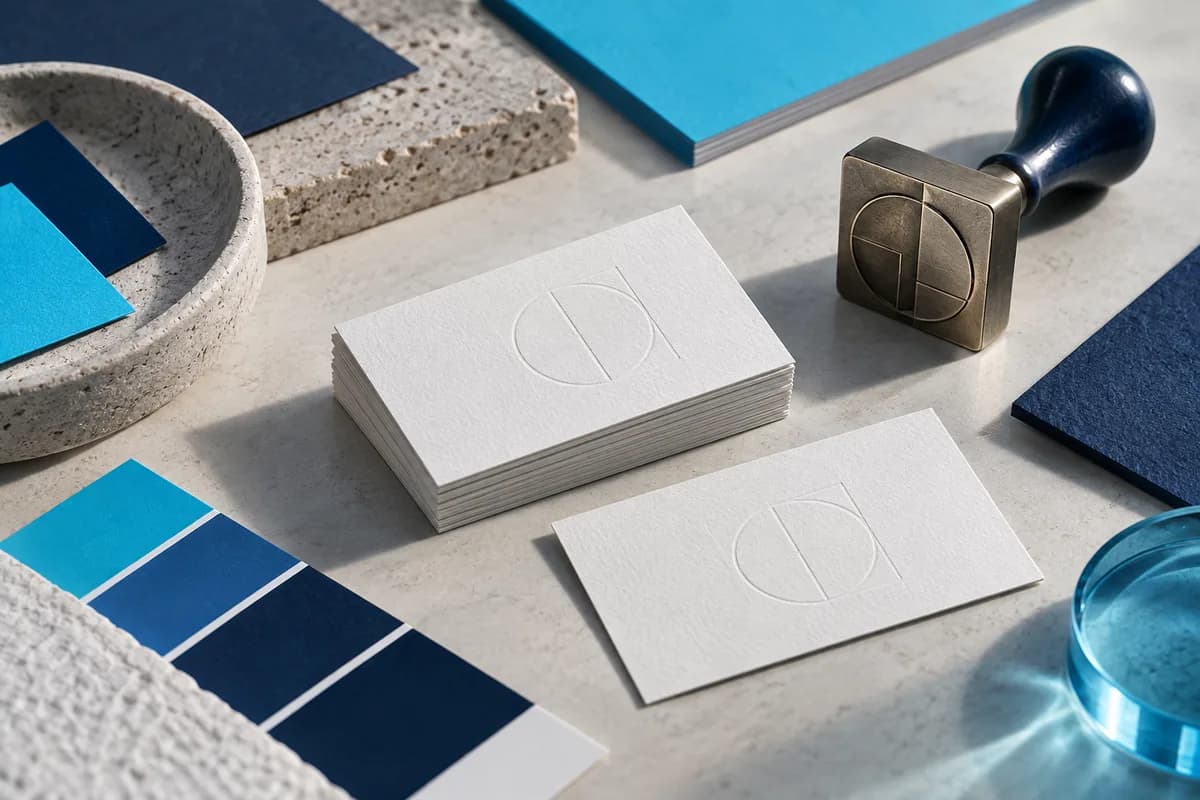
A logo, guidelines and tools that make your brand recognisable everywhere, in Arabic as in Latin script, and that your team can apply without us.
Video production & motion design
Videos with a clear job (to sell, explain, reassure or recruit), filmed on your premises and adapted to every channel and every language.
Copywriting & editorial content
Copy that makes your offer clear and moves the decision forward, written with your experts in English, French and Arabic.
Product & corporate photography
Photos that show exactly what your customers are buying and who they are dealing with, ready for your website, catalogue and social channels.
A project in this area?
Two minutes to tell us what you need, and we come back with a first read of your situation.
Reply within one business day